Why Some Sound Bath Instruments Hit You Harder Than Others
Quick Answer: Low-frequency instruments like gongs produce vibrations you feel physically in the chest and body, while higher-frequency instruments like crystal bowls register more as sound the ears process — which is why a gong pass can feel overwhelming to someone the bowls never bothered at all.
The crystal bowls barely registered. Then the gong started, and you felt it in your chest before you consciously heard it. That’s not random — different instruments genuinely do different things to your body.
1. Low frequencies are felt, not just heard
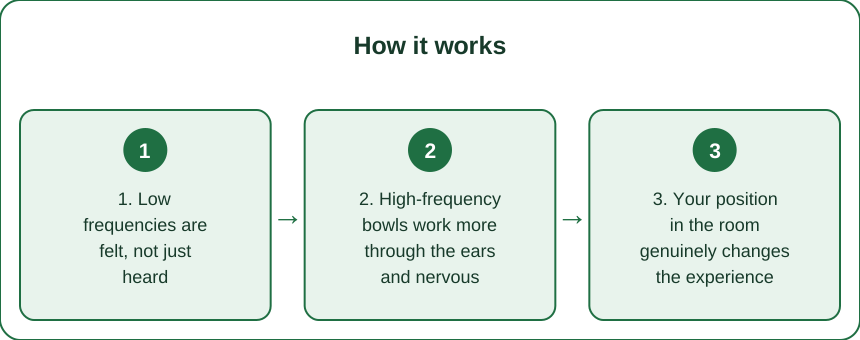
Gongs and large drums produce sound waves low enough that your body perceives them as physical vibration, not purely as audible sound, because low frequencies travel differently through tissue than high ones do. This is why a gong pass can feel intense or even a little disorienting to someone with no prior sound bath experience.
2. High-frequency bowls work more through the ears and nervous system
Crystal and metal singing bowls sit in a higher frequency range that registers primarily as sound rather than physical vibration, and their sustained tones are more associated with the nervous-system calming effect people describe as the “drop” into relaxation during a session.
3. Your position in the room genuinely changes the experience
Proximity to a gong or bowl significantly changes vibration intensity, since it diminishes with distance — someone lying close to a gong will have a measurably more intense physical experience than someone positioned across the room, even during the identical pass.

4. Reactions to specific instruments vary a lot by nervous system sensitivity
People with higher baseline sensory sensitivity often report stronger reactions to low-frequency instruments specifically, since the physical vibration component adds a sensory layer that sound alone doesn’t. This is a normal individual difference, not a sign anything is wrong.
5. Instructors sequence instruments deliberately, not randomly
Most sound bath sequences start with softer, higher-frequency instruments and build toward gongs later in the session, once your nervous system has had time to settle — starting with an intense low-frequency instrument first tends to work against the relaxation the session is meant to build toward.
FAQ: Sound Bath Instrument Questions, Answered
Is it normal to find one instrument uncomfortable and another deeply relaxing?
Yes, this is common and usually reflects individual sensory sensitivity rather than doing the session wrong.
Can I ask to sit farther from the gong if it feels too intense?
Most instructors are used to this request and can usually accommodate positioning, since intensity from proximity is a well-known factor.
Does instrument choice affect how long the relaxation effect lasts afterward?
Some practitioners report longer-lasting calm after sessions weighted toward sustained higher-frequency bowls, though this varies enough by individual that it’s worth noticing your own pattern over a few sessions.
TL;DR:
- Low-frequency instruments like gongs are physically felt as vibration, not just heard
- Higher-frequency bowls register more through the ears and nervous system
- Distance from the instrument meaningfully changes how intense the experience feels
- Sessions are usually sequenced from softer to more intense instruments on purpose
Feeling completely different reactions to a bowl versus a gong isn’t inconsistency — it’s your body responding to two genuinely different kinds of sound.
Keep Reading
This article is for general informational purposes only and is not medical advice. Always consult a qualified health professional for guidance specific to you.