11 Reasons Two People Leave the Same Sound Bath With Opposite Experiences
Quick Answer: A sound bath is not a uniform experience delivered to a room — it is a highly individual response to a shared stimulus, and it varies with where you lie, what your week has been like, your hearing, your expectations, your sleep, and how familiar the whole thing is to you. Eleven identifiable variables account for most of the difference between two people in the same room, and nearly all of them are things you can adjust before your next session.
The instruments were the same.
Almost nothing else was.

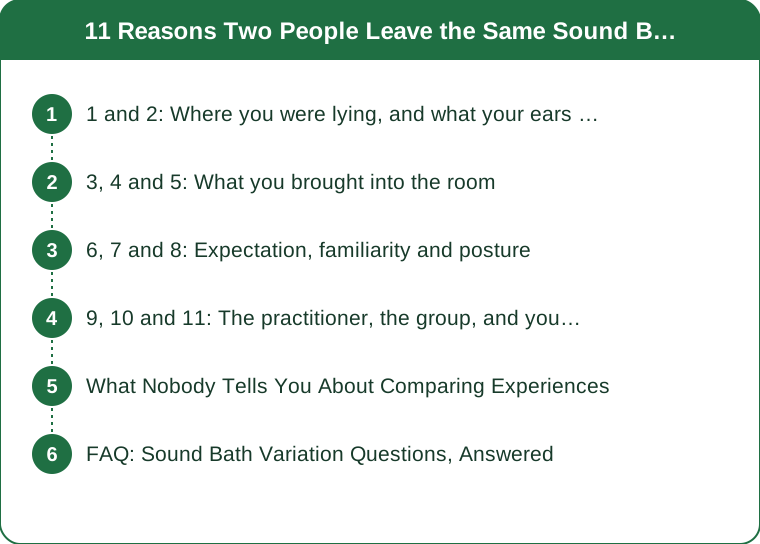
1 and 2: Where you were lying, and what your ears do with it
1. Your position in the room is a bigger variable than almost anything else
Sound in an enclosed space is not evenly distributed. Reflections from walls, floor and ceiling combine and cancel, producing areas of reinforcement and areas of relative quiet — the same acoustics that make one seat in a concert hall better than another.
With sustained tones from gongs and bowls, this effect is pronounced. Low frequencies in particular form standing waves in rooms, meaning the physical intensity of the bass you feel varies substantially depending on where you are relative to the walls.
Lying close to a gong and lying at the back of the room are genuinely different experiences. So are lying against a wall and lying in the middle. Corners tend to accumulate low frequency; centres of rooms can sit in a null for particular notes.
The practical implication is that if the session felt thin, try somewhere else next time. Arriving early enough to choose is worth more than most people realise.
2. Your hearing is not their hearing
Hearing varies enormously between individuals, particularly in the higher frequencies where age-related loss shows first. Two people can be hearing meaningfully different versions of the same overtone-rich instrument.
Sensitivity varies too. Some people find gongs at close range genuinely uncomfortable, which is not a failure to relax — it is a sensory response, and moving further back generally solves it.
And tinnitus, which is common, changes the experience of sustained tones considerably. Some people find sound baths relieve it; others find the opposite.
3, 4 and 5: What you brought into the room
3. Your baseline state going in
Someone arriving from a stressful commute with a deadline tomorrow has a very different starting nervous system from someone who took the afternoon off.
The magnitude of any relaxation effect is partly a function of how much room there is to move. Highly stressed people sometimes report the most dramatic sessions and sometimes the least — because a very activated system can take most of the hour just to begin settling.
4. Sleep debt
The single most common determinant of whether someone falls asleep during a sound bath. Which is not a problem in itself, but it does mean you experienced a nap rather than the practice, and the reports afterwards will be wildly different as a result.
If you consistently sleep through sessions, that is worth reading as information about your sleep rather than about sound baths.
5. Caffeine, food and alcohol
An hour of lying still with a coffee still working is a different hour. Same for arriving very full, or hungry enough to be distracted, or with alcohol in your system.
These are the most controllable variables on the entire list and the ones most often ignored. A session two hours after a light meal with no caffeine since morning is a genuinely different session from one after an espresso and a rushed lunch — and people who make this one change frequently report the biggest improvement of anything they try.
6, 7 and 8: Expectation, familiarity and posture
6. What you were expecting
Expectation shapes experience substantially, and this is not a criticism — it is how perception works. Someone who arrives expecting profound emotional release is primed to notice and interpret sensations that way. Someone who arrives skeptical is primed differently.
The honest version: neither is wrong, and both are experiencing a real thing filtered through what they expected.
The practically useful part is that arriving with an open, low-expectation attitude tends to produce the most consistent results. Specific expectations set up specific disappointments.
7. Whether it is your first time
First sessions are dominated by novelty. You are noticing the room, the instruments, the other people, what you are supposed to be doing, whether you are doing it right. Very little attention is available for the actual experience.
Most people report their second or third session being substantially deeper than the first, purely because the environment has stopped being new information. Judging sound baths on a single first session is judging the wrong sample.
8. Physical comfort
An hour lying still is a long time. If your lower back aches at twenty minutes, that is the dominant sensation for the remaining forty regardless of what the gong is doing.
A bolster under the knees, a rolled blanket under the neck, and being warm enough are the three that matter. Temperature especially — body temperature drops when you are still, and cold is the most common reason people report being unable to settle. As studios move into autumn, this becomes the number one comfort variable. Take an extra layer even if the room feels warm on arrival.

9, 10 and 11: The practitioner, the group, and your own attention style
9. The practitioner’s choices
What instruments, in what order, at what volume, with what pacing. A gong-heavy session is a different physical experience from a bowl-and-chime session, and practitioners vary enormously in how they build intensity.
Some sessions are designed to be enveloping and loud; others are quiet and sparse. If a session did not suit you, the practitioner’s style may simply be a mismatch rather than the format being wrong for you — and trying a different practitioner is more informative than trying the same one again.
10. The group around you
A neighbour who fidgets, snores, or arrives late changes your experience and not theirs. So does a room that is very full versus half empty, both acoustically and socially.
Group effects run both ways: some people settle faster in a full room and others find it harder.
11. How your attention naturally works
The underrated one. Some people’s attention settles readily onto sensory input; others’ defaults to verbal thought. Neither is better, and they produce very different hours.
If your mind is verbal by default, a sound bath is likely to involve considerably more noticing-that-you-are-thinking than the descriptions suggest. That is not failing at it. It is the same experience most people are having and describing more generously afterwards.
A useful reframe: the goal is not an empty mind for an hour. It is an hour of lying still with nothing required of you, which is restorative regardless of what your thoughts did during it.
What Nobody Tells You About Comparing Experiences
People describe these sessions more dramatically than they experienced them. Not dishonestly — the language available for describing a sound bath is borrowed from more dramatic experiences, and “it was quite nice and I thought about work for a while” is a socially awkward thing to say to a friend who is glowing.
Your friend’s transformative session may have been a nap. Genuinely. Falling asleep during a sound bath produces a very refreshed feeling afterwards that gets attributed to the sound.
Consistency comes with repetition. The variance between sessions narrows substantially after five or six, as novelty, position, comfort and expectation all stabilise. Early sessions are the most variable ones.
Nobody can tell how your session is going. There is no visible correct way to lie there, and the anxiety about doing it right is itself one of the bigger obstacles to it working.
A session that felt like nothing may still have done something. Judge by the rest of your evening rather than by the hour itself. Quite a lot of people report the effect arriving later.
Going with a friend changes both experiences. This is the one that explains most of the original question — attending with someone you know adds a layer of social awareness that solo attendance does not have, and comparing notes afterwards actively reshapes both people’s memory of what happened, usually in the direction of whoever describes theirs first.
FAQ: Sound Bath Variation Questions, Answered
Where should I lie for the best experience?
There is no universal best spot. Closer to the instruments is more physical and more intense; further back is gentler and often easier for a first session. Try somewhere different each time for the first few and note the difference.
Is it a problem if I fall asleep?
Not at all, and it is extremely common. It does mean you had a nap rather than the practice, so if you want the waking experience, go earlier in the day or after better sleep.
Should I go back if the first one did nothing?
Give it two or three, ideally with different practitioners. First sessions are dominated by novelty and single sessions are a poor sample of anything.
Does it matter what I eat beforehand?
More than most people think. Light food two hours before, no caffeine within four to six hours, and no alcohol. This is the cheapest available improvement.
Is a recorded sound bath the same thing?
Related but genuinely different — the low-frequency physical component that you feel rather than hear does not reproduce well through headphones or domestic speakers. Useful for relaxation, not equivalent.
Why did I feel emotional afterwards?
Reasonably common and generally unremarkable — an hour of stillness with no distraction is enough on its own to bring things to the surface. If it is persistently distressing rather than just surprising, it is worth talking to someone about rather than repeating.
TL;DR:
- Room position matters enormously because low frequencies form standing waves — the same session differs by metres
- Sleep debt, caffeine and food are the most controllable variables and the most commonly ignored
- First sessions are dominated by novelty, so judging the format on one is judging the wrong sample
- Cold is the most common reason people cannot settle, and it becomes the top comfort variable as autumn arrives
- People describe these sessions more dramatically than they experienced them, especially to a friend who went with them
For your next one, arrive early enough to pick your spot, skip the afternoon coffee, and bring a spare layer. Three small changes, none of them mystical, and together they account for more variation than the instruments do.
Keep Reading
This article is for general informational purposes only and is not medical advice. Always consult a qualified health professional for guidance specific to you.