7 Things Nobody Tells You Before Your First Sound Bath
Quick Answer: A sound bath is a lying-down session where instruments — usually singing bowls, gongs, and chimes — are played continuously for 30 to 60 minutes while you rest. You don’t do anything. Falling asleep is fine and common. Bring layers because body temperature drops when you’re still, and arrive early enough to choose your position relative to the instruments, which changes the experience more than anything else.
Most first-timers arrive with no idea what the format is, and the uncertainty itself keeps them tense for the first fifteen minutes — which is the part they’d most benefit from. Number four is the one that surprises everyone.
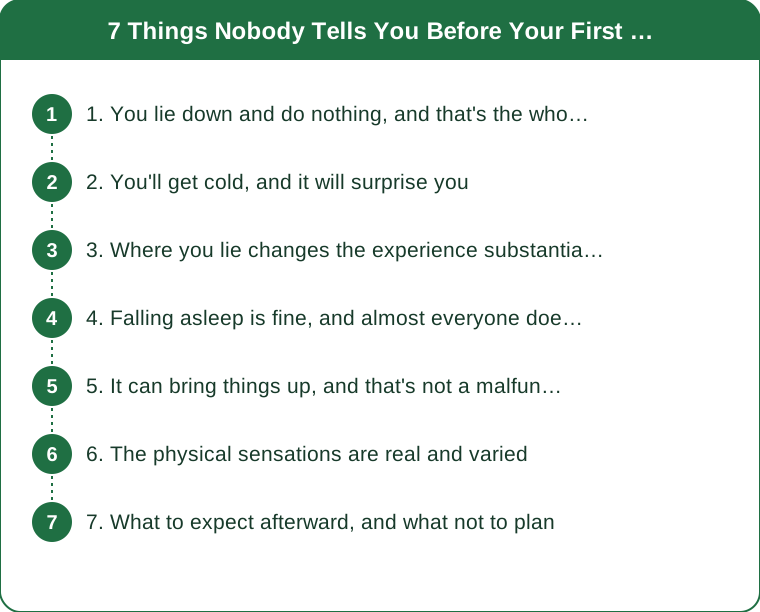
1. You lie down and do nothing, and that’s the whole instruction
There’s no technique, no posture to hold, and nothing to achieve. You lie on your back on a mat, you close your eyes, and the practitioner plays.
This catches people off guard because most wellness activities ask something of you. Yoga has poses, meditation has an instruction, breathwork has a pattern. A sound bath has none of that.
The closest thing to a technique is letting your attention go where it wants rather than directing it. If you find yourself trying to listen carefully or analyze what you’re hearing, that’s the effortful mode, and it’s the thing most likely to keep you from settling.
Sessions typically run 45 to 60 minutes, occasionally 30 for a lunchtime format. There’s usually a few minutes of settling at the start and a slow return at the end.
2. You’ll get cold, and it will surprise you
Lying still for an hour drops your core temperature noticeably. Add a dim room, minimal movement, and the parasympathetic shift the session is designed to produce — which itself lowers metabolic rate — and most people are meaningfully colder at minute forty than at minute five.
Bring socks and a layer, even in summer, even if the room feels warm when you arrive. Most studios provide blankets; some don’t, and the ones that do may run out.
A blanket also does something beyond warmth. Gentle weight across the body increases the sense of safety and helps people settle, which is why weighted blankets show up in this context at all.
And wear something you can lie in for an hour without noticing — no waistbands that dig, nothing that needs adjusting. You won’t want to move once you’ve settled.
3. Where you lie changes the experience substantially
This is the detail regulars know and first-timers never do.
Sound intensity and character vary enormously across a room. Close to a gong, you’ll feel the sound physically — it’s a full-body vibration more than a listening experience, and it can be intense. Further back, the same gong is enveloping rather than physical.
Bowls are more localized and directional than gongs. Lying near a specific bowl means hearing it distinctly rather than as part of a blend.
Room acoustics matter too. Corners and walls produce reflections and standing waves; the center of a room is usually the most even.
If you’re unsure, choose a middle distance for a first session — not right at the instruments, not against the back wall. Then adjust next time now that you know what each feels like. Arriving ten minutes early is what makes the choice possible at all.

4. Falling asleep is fine, and almost everyone does eventually
This is the concern people raise most and it’s entirely unnecessary.
Many people fall asleep, particularly in their first few sessions and particularly if they’re sleep-deprived. Practitioners expect it. Nobody minds, and there’s no version of this where you’ve done it wrong.
What’s more interesting is the state most people actually enter, which isn’t quite sleep. It’s a hypnagogic borderland — the threshold between waking and sleeping, where imagery arises, time perception distorts, and you’re not entirely sure afterward whether you were asleep.
That state is associated with reduced cortical arousal and it’s a substantial part of why sessions feel restorative out of proportion to their length.
And yes, people snore. It happens in most sessions and everyone in the room is far too relaxed to care.
5. It can bring things up, and that’s not a malfunction
A significant minority of people experience unexpected emotion — tears, a wave of sadness or relief, or a memory surfacing without obvious prompting.
The likely mechanism is straightforward. An hour of stillness with reduced external input and lowered arousal is, for many adults, the first genuinely unoccupied hour they’ve had in a long time. Things that have been queued tend to arrive.
If it happens, there’s nothing to do about it. Practitioners see it constantly and the room is dark.
What’s worth knowing in advance: if you have a trauma history, sessions can occasionally be destabilizing rather than settling, particularly with loud gong work. Sitting nearer the door, keeping eyes open, or choosing a bowls-only session are all reasonable adjustments. This is general information, not medical or psychological advice — if you’re managing PTSD or a dissociative condition, it’s worth discussing with your therapist before going.
6. The physical sensations are real and varied
People commonly report tingling, warmth spreading through the limbs, a sense of heaviness or of floating, mild pressure changes in the ears, and occasionally involuntary muscle twitches.
The twitches — hypnic jerks and small spontaneous releases — are the same phenomenon that happens at sleep onset, and they’re a sign of the nervous system downshifting rather than anything going wrong.
Low-frequency instruments produce genuine mechanical vibration in the body, particularly gongs. If you’re close, you’ll feel it in the chest and sternum. Some people find this profoundly pleasant and some find it too much, which is again about where you lie.
One practical note: ear pressure or discomfort near a loud gong is a real thing. Sound levels near large gongs can be substantial. If it’s uncomfortable, move — practitioners would much rather you relocate mid-session than endure it.
7. What to expect afterward, and what not to plan
Most people are noticeably slowed for 30 to 90 minutes afterward — a slightly foggy, unhurried state that’s pleasant and not ideal for anything demanding.
Don’t schedule anything sharp immediately after. A meeting, a difficult conversation, or a long drive are all worse ideas than they seem when you’re booking.
Hydrate, and eat something if you were fasting. Some people report mild headache afterward, which is usually dehydration or having skipped a meal rather than anything else.
Sleep that night is frequently better than usual, and it’s one of the more consistently reported effects.
As for what sound baths do beyond this: the honest position is that evidence for deep relaxation and short-term stress and anxiety reduction is reasonable, while claims about cellular healing, frequency-specific effects on organs, or DNA repair are not supported. It’s a genuinely restorative hour of guided rest, which is a real thing to want and doesn’t need the additional claims.
TL;DR:
- You lie down and do nothing; sessions run 45 to 60 minutes and there’s no technique.
- Bring socks and a layer — you’ll get colder than you expect lying still for an hour.
- Arrive early and choose your position; distance from the gong changes everything.
- Falling asleep is normal, emotion surfacing is normal, and both are expected by practitioners.
- Leave 30 to 90 minutes afterward unscheduled and drink water.
Almost everything that makes a first sound bath awkward is logistical rather than experiential — not knowing the format, sitting in the wrong place, being cold, and having a meeting at four. Handle those five things and the hour does what it’s supposed to do, which is give you the least demanding sixty minutes you’ve had in a while.
Keep Reading
This article is for general informational purposes only and is not medical advice. Always consult a qualified health professional for guidance specific to you.