9 Things That Ruin a Sound Bath for Everyone Else in the Room
Quick Answer: The disruptions that matter are the ones that break other people’s descent into a settled state — arriving late, phone sounds, restless repositioning, whispered conversation, and leaving mid-session. Most of them are fixable with two minutes of preparation before you lie down. What people actually worry about — falling asleep, snoring, crying — is almost entirely fine.
Nobody hands you a list at the door. So here is the list, ranked roughly by how much damage each one does to the person on the mat next to you.

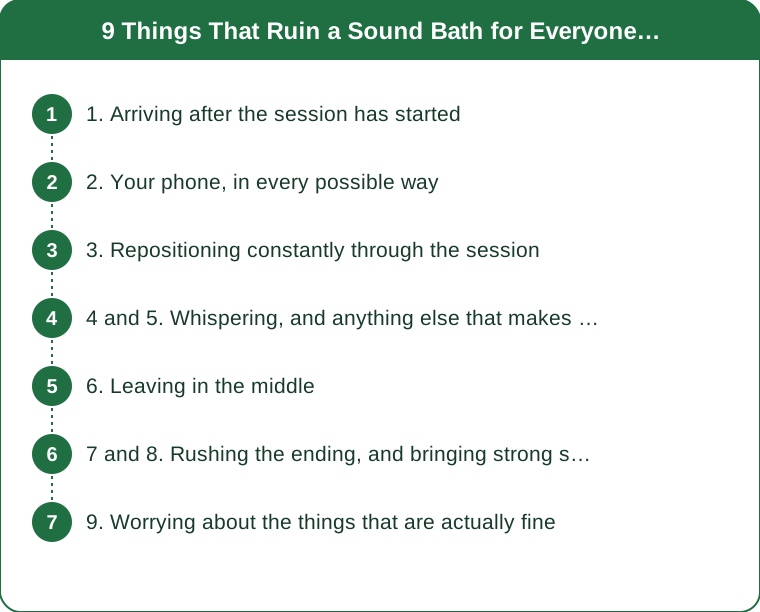
1. Arriving after the session has started
This is the biggest one by a distance, and it is the most common.
A sound bath works by getting a room full of people into a settled, downshifted state, and the first ten minutes are when that happens. Someone opening a door, finding a spot in the dark, unrolling a mat, and arranging blankets during that window resets a substantial part of the room.
The physiology is not subtle. A novel sound in a dark room triggers an orienting response — attention snaps toward it, heart rate ticks up. Everyone within earshot has just been pulled back to the start.
Arrive fifteen minutes early, not five. You need time to find a spot, get blankets, use the bathroom, and lie down before anything begins. Most studios will not admit latecomers at all, which is a policy that exists for exactly this reason.
And if you are genuinely late, do not go in. Wait for a break if there is one, or accept the loss. Slipping in quietly is not actually quiet from inside the room.
2. Your phone, in every possible way
Silent is not enough. Vibrate is arguably worse.
A phone on vibrate against a hard floor is louder than most people realize and it carries through the floor to nearby mats. In a room designed to be acoustically resonant, a buzzing phone is genuinely disruptive.
Do this instead: airplane mode, then also silent, then face down in a bag rather than beside your mat. Airplane mode is the only setting that actually guarantees nothing happens.
Screen light is the second half of the problem. A screen lighting up in a dark room is visible to everyone facing that direction, even with eyes closed for some people. If you must check the time, the answer is do not.
And no photos. The shutter sound, the light, and the fact that everyone else came to be somewhere unrecorded. If the studio permits photos, they will say so, and it will be before or after.
3. Repositioning constantly through the session
Small movements are fine. A full rearrangement every four minutes is not.
Sound baths run 45 to 75 minutes and lying still that long is genuinely uncomfortable if you are not set up well. The fix happens before the session, not during it.
Set up properly in the first two minutes:
- A cushion or bolster under the knees. This is the single most effective comfort adjustment and it prevents most lower back discomfort.
- A blanket, always. Body temperature drops when you lie still, and being cold at minute forty is the most common reason people start fidgeting.
- Something under your head, thin rather than thick.
- Arms at your sides, palms up, so your shoulders can release.
If you do need to move mid-session, move slowly and once. A single deliberate adjustment is nearly silent. Five restless shuffles are not. And rolling onto your side is completely acceptable if lying flat becomes uncomfortable.

4 and 5. Whispering, and anything else that makes noise
Whispering to the person you came with
There is no such thing as a quiet whisper in a resonant room.
Studios that host sound baths are usually chosen or treated for acoustics, which means they carry sound extremely well — that is the point. A whisper travels considerably further than the whisperer imagines, and whispered speech is acoustically more attention-grabbing than normal speech because the brain works harder to parse it.
This includes the small stuff: checking whether your friend is comfortable, a shared reaction to an instrument, a laugh. All of it lands on the mats around you.
The practical rule: the room goes silent when you enter it, not when the facilitator starts. Say what you need to say outside, and treat the space itself as part of the session.
Wearing anything that rustles or clicks
Jewelry and jackets are the two nobody thinks about.
Bracelets, bangles, and long necklaces click and shift with every breath and small movement. In a quiet room this is audible to your neighbors for the entire session. Take them off and put them in your bag rather than beside your mat.
Technical jackets and synthetic outerwear rustle loudly. So do certain athletic pants. If you can hear your own clothing when you move an arm, so can everyone nearby.
A watch that beeps or a fitness tracker with notifications — turn it off entirely. Smartwatch haptics are the modern version of this problem and they are extremely common.
What to wear instead: soft, quiet, layered, and warmer than you think you need. Socks matter more than people expect, because feet get cold first when lying still and cold feet are the thing that makes people fidget at minute fifty.
6. Leaving in the middle
Sometimes necessary, usually avoidable, and worth handling correctly when it is not.
Standing up and walking out mid-session is disruptive in every dimension — movement, sound, light from the door, and the concern it creates in everyone who notices.
Prevent it:
- Use the bathroom immediately before, even if you do not feel you need to. A 70-minute session is long.
- Do not drink a large amount of water in the half hour beforehand. Hydrate earlier in the day.
- Set yourself up comfortably so discomfort does not become the reason.
If you genuinely need to leave — feeling unwell, an emotional response you would rather have privately, a real emergency — lie near the door if you have any reason to suspect you might. Move slowly, leave your things, and go. Nobody will judge it. And tell the facilitator afterward if something in the session caused it, because they would want to know.
7 and 8. Rushing the ending, and bringing strong scents
Treating the closing as the credits
The last few minutes and the silence after are part of the session, not the end of it.
When the instruments stop, there is usually a period of silence that is deliberately included. That silence is where a lot of the actual effect settles — the nervous system needs a moment without input to integrate what just happened.
Sitting up immediately, reaching for your phone, or starting to roll your mat during that silence takes it away from everyone else.
Wait for the facilitator’s cue. Then come up slowly — sitting up too fast after 60 minutes lying still causes genuine lightheadedness and it wastes the settled state you just built.
Keep the room quiet as you pack up. The talking starts outside. This one costs nothing and it is the difference between a room that ends well and one that ends like a gym class.
Bringing strong scents
The most invisible disruption on this list.
Lying still in a dim room with your eyes closed heightens every remaining sense, and smell becomes far more prominent than it is normally. Strong perfume, cologne, essential oils applied before arriving, or heavily scented laundry detergent are all noticeable from several mats away.
Beyond preference, a meaningful number of people have genuine scent sensitivity or migraine triggers, and a sound bath is exactly the setting where they cannot easily move away from it.
Many studios ask for scent-free attendance and most do not think to mention it. Skip the perfume, and skip applying oils right before. The same logic applies to strong-smelling food beforehand — not a moral issue, just a small consideration that costs you nothing.
9. Worrying about the things that are actually fine
The final one is a reversal, because a lot of people spend the session anxious about things nobody minds.
Falling asleep is fine. It is extremely common, facilitators expect it, and the sound still affects you. Snoring is fine too — mildly funny, entirely forgivable, and not something anyone will remember.
Crying is fine. Emotional release happens in these sessions regularly and quiet tears disturb nobody. Facilitators are used to it.
Your stomach making noise is fine. Everyone’s does.
Not feeling anything is fine. Some sessions land and some do not, and a session where nothing dramatic happens is not a failed session.
Needing to move, roll over, or bend your knees is fine. Slowly and once, and nobody notices.
Here is what the real list has in common: the disruptive things are all avoidable with preparation, and the things people worry about are all involuntary. Nobody minds what your body does. They mind what your phone does. Arrive early, turn everything off, set up warm and comfortable, and then whatever happens is allowed to happen.
TL;DR:
- Arrive fifteen minutes early — late entry is the single most disruptive thing possible
- Airplane mode, not silent, and phone in a bag rather than beside your mat
- Set up warm and comfortable before it starts: bolster under the knees, blanket, socks
- No jewelry, no strong scents, no whispering, and stay through the closing silence
- Sleeping, snoring, crying, and feeling nothing are all completely fine
The pattern is simple: the things worth avoiding are the ones you can decide about beforehand, and the things people fret about are the ones your body does on its own. Sort the first list out and the rest takes care of itself.
Keep Reading
This article is for general informational purposes only and is not medical advice. Always consult a qualified health professional for guidance specific to you.