9 Sound Bath Mistakes That Happen Before the Session Even Starts
Quick Answer: The variables that most determine a sound bath experience — where you lie relative to the instruments, how warm you’ll be lying still for an hour, how recently you ate or had caffeine, and whether your nervous system arrived settled or rushed — are all fixed before the session begins. The practitioner controls the sound; you control almost everything else.
You went, you lay there, you felt nothing much, and you concluded sound baths aren’t for you. Nine things worth checking first, because most of them were already decided when you walked in.

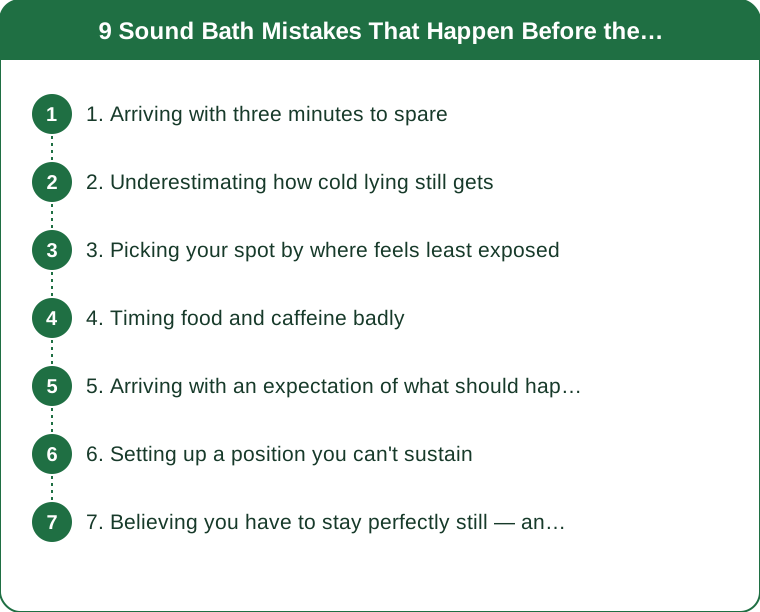
1. Arriving with three minutes to spare
The single most common one, and the most consequential.
Arriving rushed means starting the session in sympathetic activation — elevated heart rate, shallow breathing, attention still on traffic and parking. The first fifteen minutes then get spent coming down from that rather than going anywhere.
A sound bath is typically 45 to 60 minutes. Losing the first quarter of it to arrival stress is losing a substantial portion of what you came for.
Arrive fifteen minutes early. Sit. Don’t look at your phone. The practitioners who ask you to arrive early aren’t being fussy about logistics — they’re protecting the first third of your session.
2. Not accounting for how cold you’ll get. Covered next, because it’s the one people are most surprised by.
2. Underestimating how cold lying still gets
You are at your lowest heat production of the day when lying motionless, and a room that feels comfortable when you walk in will feel cold by minute twenty.
Studios are often kept cooler than living rooms, and you’ll be still for an hour. Cold pulls attention to the skin surface, which is exactly the attention you were hoping to direct inward.
Bring socks and a layer beyond what the room seems to need. Most studios provide blankets; most people take one when two would have been right. Cold feet at minute forty is one of the most common reasons people report they couldn’t settle.
3. Choosing a spot for privacy instead of for sound.
3. Picking your spot by where feels least exposed
People instinctively take the back corner. Sound doesn’t distribute evenly in a room, and the corner is usually the worst seat in it.
Low frequencies build up in corners and along walls, which produces a boomy, muddy version of what the practitioner is playing. The clear, detailed sound — the part that produces the sensation people describe as physical — is generally in the middle third of the room.
Being close to a gong is a different experience from being far from one. Very close, you feel it in your chest; further away, you hear it. Neither is wrong, but they’re genuinely different, and picking without knowing means getting whichever you happened to land on.
Ask the practitioner where they’d suggest lying if it’s your first time at that space. They know their room, and almost nobody asks.
4. Eating a full meal beforehand.

4. Timing food and caffeine badly
Both change what your body is doing during the session, and both are easy to control.
A full meal within an hour means active digestion, which produces internal sensation and often drowsiness. Lying flat on a full stomach also causes reflux for many people, which is a poor accompaniment to an hour of stillness.
Caffeine within three or four hours keeps sympathetic tone elevated. People who report restlessness through the whole session very often had an afternoon coffee they didn’t connect to it.
Aim for a light snack 90 minutes before, and shift caffeine to the morning on a session day.
Alcohol beforehand is worth avoiding too — it flattens the experience and typically produces drowsiness rather than the settled alertness that makes a session memorable.
5. Expecting a specific outcome.
5. Arriving with an expectation of what should happen
This one reliably undermines the session for people who’ve read about it beforehand.
Expecting a release, a vision, or a profound emotional experience creates a monitoring process — you spend the session checking whether it’s happening. Monitoring is an analytical activity and it keeps you in exactly the state you’re trying to leave.
The common experiences are more ordinary than the marketing suggests: drifting between sleep and waking, losing track of time, a physical sense of vibration in the chest or hands, occasionally an unexpected emotion. Sometimes nothing much at all, which is a normal outcome and not a failure.
First sessions are frequently the least dramatic because novelty keeps you alert and observing. This is why practitioners suggest trying three before deciding.
6. Lying in a position you can’t hold for an hour.
6. Setting up a position you can’t sustain
You will not adjust as freely as you think once the room is quiet and everyone is still.
Test the position before it starts. Lie down, wait two minutes, and notice your lower back and neck. A position that’s fine for two minutes is often not fine for fifty, and the classic failure is a flat-on-back position with an unsupported lumbar curve.
A bolster or rolled blanket under the knees takes pressure off the lower back and is the single most useful adjustment for lying flat. Under the head, a thin support keeps the neck neutral — most people use a pillow that’s too thick.
Side-lying is completely acceptable if flat on the back doesn’t work for you, and so is a chair. Practitioners expect this; participants assume it isn’t allowed.
7. Assuming you shouldn’t move at all.
7. Believing you have to stay perfectly still — and 8 and 9
Three more, quickly, because they share a root: treating the session as something with rules you might break.
7. You can move. Shifting position quietly is fine and expected. People lie in genuine discomfort for forty minutes because they think adjusting would disturb others. It wouldn’t, and the discomfort is far more disruptive to your own session than the movement would be to anyone else’s.
8. Falling asleep isn’t a failure. Many people drift in and out, and the drifting state is where a lot of the reported benefit comes from. If you sleep through the whole thing, you were probably tired, and that’s information rather than a wasted session. If you consistently sleep through and want more of the experience, try a morning or midday session rather than an evening one.
9. Leaving immediately afterward. The five to ten minutes after the last sound fades is when most people report the strongest sense of the effect, and it’s when the transition back matters. Standing up quickly, grabbing your phone, and driving off truncates the part that carries into the rest of the day. Sit for five minutes before you look at anything. In autumn especially, when sessions end after dark and the instinct is to rush to the car, this is the step most likely to get skipped.
TL;DR:
- Arrive fifteen minutes early — a rushed arrival costs you the first third of the session
- Bring more warmth than the room seems to need; lying still is your lowest heat-production state
- Avoid the back corner, where low frequencies pile up; ask the practitioner where to lie
- Light snack 90 minutes before, no caffeine within four hours, no alcohol
- Drop the expectation of a dramatic experience — monitoring for one prevents it
- Test your position for two minutes first, and support the knees and neck
- You’re allowed to move, allowed to fall asleep, and shouldn’t leave the moment it ends
Nearly everything that determines a sound bath happens before the first note. The practitioner has the instruments; you have the other nine variables.
Keep Reading
This article is for general informational purposes only and is not medical advice. Always consult a qualified health professional for guidance specific to you.