7 Things Nobody Tells You Before Your First Sound Bath Session
Quick Answer: A sound bath is a passive listening practice using instruments like singing bowls and gongs to guide the nervous system into a relaxed state — no participation, movement, or musical knowledge is expected, and feeling emotional, restless, or even bored during your first session is completely normal.
You walked in not quite sure what to do with your body, your eyes, or your expectations. That confusion is universal for first-timers, and most of it comes down to nobody explaining these seven things beforehand.

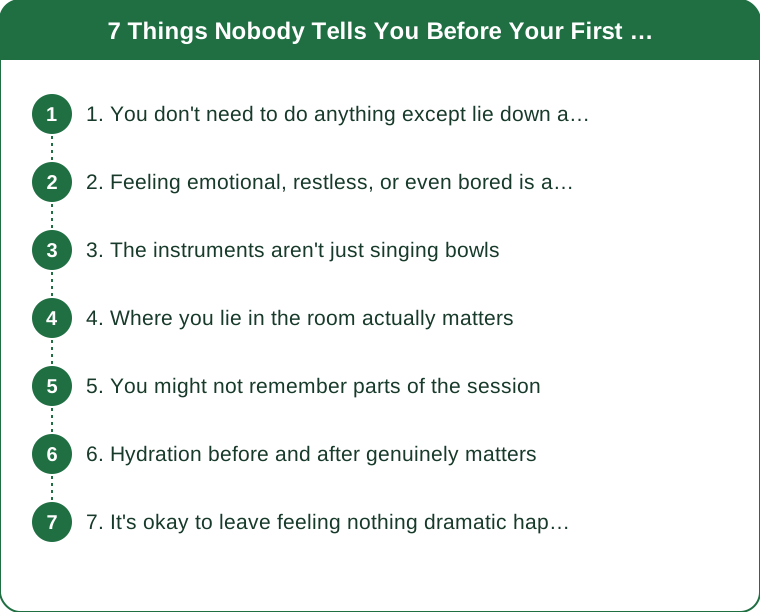
1. You don’t need to do anything except lie down and listen
Sound baths are entirely passive — there’s no chanting back, no movement, no participation expected at any point. Bringing a mat, blanket, and maybe an eye mask, then simply lying still and letting the sound happen around you, is the entire practice. This surprises a lot of first-timers who arrive braced for some kind of active involvement.
2. Feeling emotional, restless, or even bored is all normal
Some people cry unexpectedly, some feel deeply relaxed, and some spend the whole session mentally listing groceries — all of these are common, normal responses, not signs you’re ‘doing it wrong.’ The nervous system doesn’t respond identically session to session even for the same person, so don’t judge your first experience against what you expected or what others describe.
3. The instruments aren’t just singing bowls
Most sound baths combine crystal or metal singing bowls with gongs, chimes, tuning forks, and sometimes drums, each producing different frequency ranges that affect the body differently. Gongs in particular produce a much more physically felt vibration than bowls, which can be intense or even startling for first-timers who only expected a gentle bowl tone.

4. Where you lie in the room actually matters
Positions closer to gongs or large bowls receive a noticeably stronger vibrational and volume experience than spots farther away — if you’re sensitive to loud or intense sound, arriving early to choose a spot farther from the instruments is a reasonable, common accommodation, not something to feel awkward about.
5. You might not remember parts of the session
Many people report drifting into a state between waking and sleeping, sometimes losing track of time or portions of the session entirely — this is a commonly reported, generally welcomed effect of the deep relaxation state sound baths aim to induce, not a sign anything went wrong.
6. Hydration before and after genuinely matters
Practitioners commonly recommend drinking water before and after a sound bath, as the deep relaxation state can sometimes bring on mild headaches or grogginess afterward, similar to how some people feel after deep sleep or a long massage. This isn’t a scientifically proven necessity, but it’s widely recommended and low-risk to follow.
7. It’s okay to leave feeling nothing dramatic happened
Not every first sound bath produces an obviously profound experience, and that doesn’t mean the practice ‘doesn’t work for you.’ Many regular practitioners describe cumulative benefits building over several sessions rather than one dramatic first-time shift, so a subdued first experience isn’t a reliable predictor of longer-term value.
Do I need to bring my own mat and blanket?
Most studios provide them, but checking ahead saves an awkward surprise — some smaller pop-up sessions expect you to bring your own.
Is it weird to fall asleep during a sound bath?
Not at all — many practitioners consider it a sign of successful deep relaxation rather than a failure to ‘meditate properly.‘
How soon should I expect to feel benefits?
Some people notice immediate calm after one session; others find it takes 3-4 sessions before effects become noticeably consistent.
TL;DR:
- Sound baths are entirely passive — just lie down and listen, no participation needed
- Emotional reactions, restlessness, or boredom are all normal, not signs of doing it wrong
- Instruments beyond bowls (gongs especially) can feel more physically intense than expected
- Seating position, hydration, and a subdued first experience are all worth knowing beforehand
Going in with these seven expectations set correctly makes a first sound bath far less confusing than walking in blind.
Keep Reading
This article is for general informational purposes only and is not medical advice. Always consult a qualified health professional for guidance specific to you.