7 Reasons You Might Feel Nothing During a Sound Bath (and What Actually Helps)
Quick Answer: Feeling little or nothing during a first sound bath is common and usually comes down to a mismatch between expectation and normal first-time response, an unfamiliar environment your nervous system hasn’t relaxed into yet, or simple sensory factors like positioning and instrument distance. It rarely means sound baths “don’t work” for you specifically.
Glowing sound bath reviews can set up an expectation of an immediate, dramatic experience — and when that doesn’t happen, it’s easy to assume something’s wrong with you or the practice. Neither is usually true. Here are the seven most common, specific reasons behind a flat first experience.

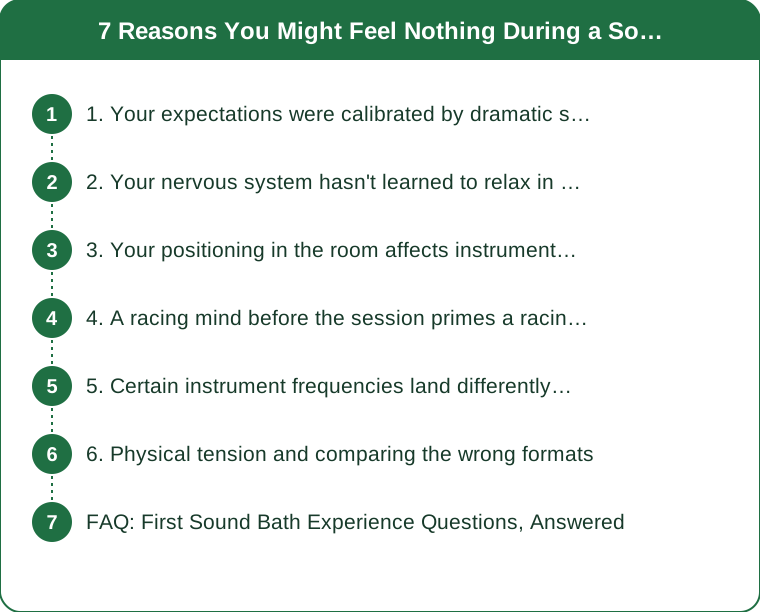
1. Your expectations were calibrated by dramatic secondhand accounts
The loudest online accounts of sound baths tend to be the most intense outlier experiences, not the median one. Most people’s actual first session is calm and pleasant rather than transformative — that’s a completely normal, valid response, not a failed one. Expecting an intense reaction on session one sets up almost everyone for disappointment regardless of how well the session objectively went.
2. Your nervous system hasn’t learned to relax in that specific setting yet
A first-time environment (new space, unfamiliar people nearby, unclear what to expect next) keeps a low level of alertness active, even in a relaxation-focused setting. Many regular practitioners report their second or third session feels noticeably deeper than their first, simply because their body has learned the setting is safe and predictable.
3. Your positioning in the room affects instrument intensity substantially
Sound and vibration intensity drop off meaningfully with distance from the instruments, especially with gongs and singing bowls, which rely partly on felt vibration, not just heard sound. A spot near the back or edge of a large group session delivers a genuinely different experience than a spot near the front — this is a physical, not just psychological, factor.

4. A racing mind before the session primes a racing mind during it
Arriving rushed, stressed, or straight from a demanding task carries that mental state directly into the session — a sound bath doesn’t instantly override an already activated stress response, it works more gradually. Arriving 10-15 minutes early to simply sit quietly before the session starts noticeably changes how receptive most people are once the sounds begin.
5. Certain instrument frequencies land differently for different people
Individual response to specific frequencies (gongs vs. crystal bowls vs. Tibetan bowls) genuinely varies person to person — some people respond much more to lower, resonant tones, others to higher, sustained ones. A session heavy in instruments that don’t resonate with you personally can feel flat even if the overall session was well-executed.
6. Physical tension and comparing the wrong formats
Physical tension is blocking the felt sensation of the sound. Chronic physical tension (tight shoulders, a clenched jaw, shallow breathing) can dampen how much vibration and sound you actually feel, since a tense body absorbs and transmits sensation differently than a relaxed one. A few minutes of conscious muscle relaxation (a mini body scan) before the sounds begin often opens up noticeably more felt sensation.
You’re comparing an in-person session to a headphone recording, or vice versa. Recorded sound baths and live in-person sessions are genuinely different experiences — live sessions include felt vibration through the floor and air that headphones can’t reproduce, while headphone versions offer more controlled, isolated sound. Comparing a flat live experience to an intense recorded one (or vice versa) isn’t a fair comparison of the practice itself.
FAQ: First Sound Bath Experience Questions, Answered
Does feeling nothing mean sound baths just aren’t for me?
Not based on one session — most practitioners recommend trying at least 2-3 sessions before drawing a conclusion, since the nervous-system familiarity factor alone changes a lot between first and third sessions.
Should I tell the facilitator I didn’t feel much?
Yes, it’s welcome feedback — many facilitators can suggest a better spot in the room or adjust expectations for your next session based on what you share.
Is it normal to fall asleep instead of feeling any specific sensation?
Very normal, and considered a positive sign of relaxation by most practitioners, not a failure to “do it right.”
TL;DR:
- A flat first sound bath is common and rarely means the practice doesn’t work for you
- Expectation mismatch, room positioning, and pre-session mental state all measurably affect the experience
- Physical tension can dampen how much vibration you actually feel — a body scan beforehand helps
- Give it 2-3 sessions before concluding it’s not for you — nervous system familiarity builds over repeat visits
A quiet, uneventful first sound bath isn’t a sign to give up on it — it’s usually just session one of a practice that tends to deepen with repetition.
Keep Reading
This article is for general informational purposes only and is not medical advice. Always consult a qualified health professional for guidance specific to you.