7 Reasons a Recorded Sound Bath Never Works as Well Through Headphones
Quick Answer: A live sound bath delivers physical vibration through your body, not just sound through your ears - and headphones can only deliver the second. Add the lost low frequencies, the compressed dynamic range of a recording, the absent room, the missing social and ritual framing, and the fact that you are at home surrounded by your own to-do list, and seven distinct things have been removed. Three of them are recoverable at home; the rest are genuinely why people go to studios.
Here they are, in order of how much they matter.
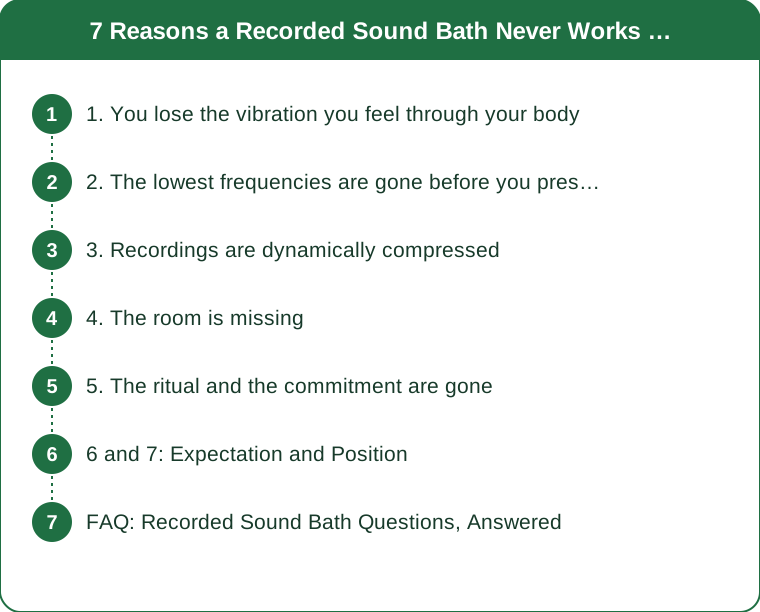
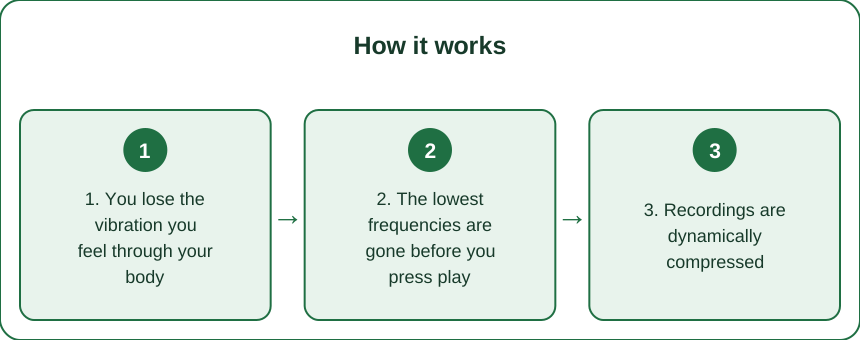
1. You lose the vibration you feel through your body
In a live session, low frequencies arrive through your chest, floor, and bones - not only your ears. A large gong or a low bowl moves air with enough energy that you feel it physically, and that tactile component is a substantial part of the experience.
Headphones cannot reproduce this. They deliver sound to your eardrums and nothing to the rest of you. Even excellent headphones with strong bass extension produce no whole-body sensation, because the mechanism is different - it requires moving a large volume of air.
This is the single largest missing element, and it explains most of the gap people notice. What they remember as the sound was partly a physical sensation.
Speakers recover some of it, and floor contact recovers more. Lying on a wooden floor near speakers with reasonable bass transmits some vibration through the surface - not equivalent, but noticeably better than headphones.
And this is why proximity matters in a studio too. People who lie close to the gong report a stronger experience than those at the back, for exactly this reason - the tactile component falls off quickly with distance.
2. The lowest frequencies are gone before you press play
Most consumer headphones roll off below about 20 to 40Hz, and much of what makes a gong feel enormous lives at and below that boundary.
Recording adds its own losses. Microphones, compression for streaming, and file encoding all reduce the lowest end further, often before the file ever reaches you.
The perceptual effect is disproportionate. Losing the bottom octave does not make it slightly quieter - it removes the sense of a sound having physical size, which is the quality people are chasing.
Streaming compression is worth checking. A lossy stream at a low bitrate treats the extreme low end and the very quiet passages as expendable. A higher-quality file or a lossless stream is a genuine improvement for this material specifically.
And speakers with any real bass extension outperform almost any headphone here. If you have a choice, speakers plus floor contact beats headphones for this content, which is the reverse of most listening advice.
3. Recordings are dynamically compressed
Live sound baths have enormous dynamic range - near-silence to a gong swell that fills the room. Recordings are usually compressed so they are audible on phone speakers and in cars.
Compression removes the swell. The gradual build that produces the feeling of being enveloped is precisely what gets flattened, because the quiet parts are raised and the loud parts reduced.
The near-silence matters as much as the loud parts. Long quiet passages are where a live session does much of its work, and they are the first thing to be edited or filled in a recording made for streaming.
Look for recordings that state they are uncompressed or minimally mastered. Some practitioners release both versions, and the difference on this material is much larger than on music.
And do not use any listening mode that adds processing. Loudness normalisation, EQ presets, and spatial audio effects all interfere further with material whose whole point is unprocessed dynamics.
4. The room is missing
A studio room is part of the instrument. Reverberation, reflections, and the specific decay of the space are what make a bowl sound like it continues rather than stopping.
Headphones place the sound inside your head. The spatial impression of sound arriving from around you, at different distances, is largely lost - and that sense of being surrounded is a significant part of the effect.
Recordings capture one room, not yours. You are hearing a studio’s acoustics reproduced in a way that does not interact with your space at all, which is why it can feel oddly flat and disconnected.
Speakers in a small hard-surfaced room recover a little of it, because your own room adds reflections. A carpeted, heavily furnished room adds almost none.
And this is where binaural recordings genuinely help. A recording made with a binaural head preserves much more spatial information over headphones than a standard stereo recording does. If you use headphones, look specifically for binaural.
5. The ritual and the commitment are gone
Travelling to a studio, arriving early, and lying down in a space with no other purpose is a substantial part of the effect. You have committed time and money and there is nothing else you could be doing.
At home, you can stop at any point - and knowing that changes how you listen. The lack of a boundary is why home sessions so often end early.
Your home is full of cues to do something else. The washing, the desk, the phone. A studio has no cues at all, which is most of what makes it work.
Other people in the room matter more than people expect. Group settings produce a shared quality of attention, and hearing others settle gives permission to settle.
This is the most recoverable one. Same time each week, phone in another room, door closed, blanket, timer set, nothing else planned for the following 30 minutes. Building an actual ritual around the recording restores a real share of the effect - and it costs nothing.
6 and 7: Expectation and Position
6. You are expecting the studio experience
Comparison is itself an obstacle. Listening while evaluating whether it matches the studio keeps you in an analytical mode, which is incompatible with settling.
Treat the recording as a different practice rather than a substitute. It is closer to guided rest with sound than to a live sound bath, and it works better when approached that way.
Novelty played a bigger role than most people credit. A first live session is powerful partly because it is unfamiliar. The tenth listen of the same recording cannot reproduce that, and neither could a tenth live session with the same practitioner.
And do not chase the peak experience. People who had one strong session often spend months trying to recreate it. The consistent modest benefit is the useful thing, and it is available at home.
7. You are probably lying badly
Comfort determines almost everything and gets no attention. In a studio you are set up properly with bolsters, a mat, and a blanket. At home most people lie on a sofa or a hard floor and shift position throughout.
Support the knees and the neck. A cushion under the knees releases the lower back; a thin pillow under the head keeps the neck neutral. Without both, discomfort accumulates and takes your attention.
Warmth is essential and consistently underestimated. Body temperature drops when you lie still, and a cold room in autumn will end a session early. A blanket is not optional.
Lie down rather than sitting. The effect is meaningfully stronger lying flat, and if you are worried about falling asleep, that is usually a sign you needed the sleep.
And get the volume right. Loud enough to be enveloping, quiet enough that you never brace against a peak - which is easier with speakers than with headphones, where a sudden gong swell can be genuinely unpleasant.
FAQ: Recorded Sound Bath Questions, Answered
Are headphones or speakers better for a sound bath recording?
Speakers, if you have the option - especially with floor contact, which recovers some of the physical vibration headphones cannot produce at all. Binaural recordings are the exception where headphones win.
Why does a recording feel so much flatter than the live session?
The biggest reason is the missing tactile vibration, followed by lost low frequencies and dynamic compression. You remembered a physical sensation as well as a sound.
Does audio quality actually matter here?
More than for most music. Lossy compression discards the extreme low end and the very quiet passages, which on this material are doing much of the work.
Should I use spatial audio or an EQ preset?
No. Any added processing interferes with material whose entire point is unprocessed dynamics and natural decay.
How long should a home session be?
Twenty to thirty minutes is plenty, and consistency beats duration. A shorter session you actually finish is more useful than a long one you abandon.
Can a recording ever match a live session?
Not fully - the physical vibration cannot be reproduced through headphones. It can be a genuinely useful practice in its own right, which is a different claim.
What is the single best improvement I can make at home?
Build a real ritual: same time, phone elsewhere, door closed, properly supported on the floor with a blanket, nothing planned afterwards. It costs nothing and recovers a real share of the effect.
TL;DR:
- The biggest loss is physical vibration. Headphones deliver sound to your ears and nothing to your body - that tactile element was part of what you remember.
- Low frequencies vanish twice: headphone roll-off plus recording and streaming compression.
- Recordings are dynamically compressed, which flattens the gong swell and fills the near-silence that does much of the work.
- The room is missing. Binaural recordings recover the most over headphones; speakers plus a hard floor recover the most overall.
- Ritual is the most recoverable element - same time, phone elsewhere, door closed, nothing planned after.
- Lie down properly: cushion under the knees, thin pillow under the head, and a blanket. Cold ends sessions early.
- Stop comparing it to the studio. It is guided rest with sound, and it works better treated as its own thing.
Speakers with floor contact beat headphones for this material - the reverse of usual listening advice.
Keep Reading
This article is for general informational purposes only and is not medical advice. Always consult a qualified health professional for guidance specific to you.