7 Reasons a Recorded Sound Bath Does Not Land the Same as a Live One
Quick Answer: Live sound baths deliver low-frequency energy you feel physically as well as hear, in a room where the sound arrives from many directions and is unpredictable in timing. Recordings compress the dynamic range, lose most of the bass you feel in your body, arrive from two fixed points, and become predictable with repetition. Recordings are genuinely useful — they are simply doing a different thing.
You loved the live session and bought the recording so you could have it at home. It is pleasant. It is not the same.
Seven specific things are different, and knowing which ones matter helps you get more out of both.
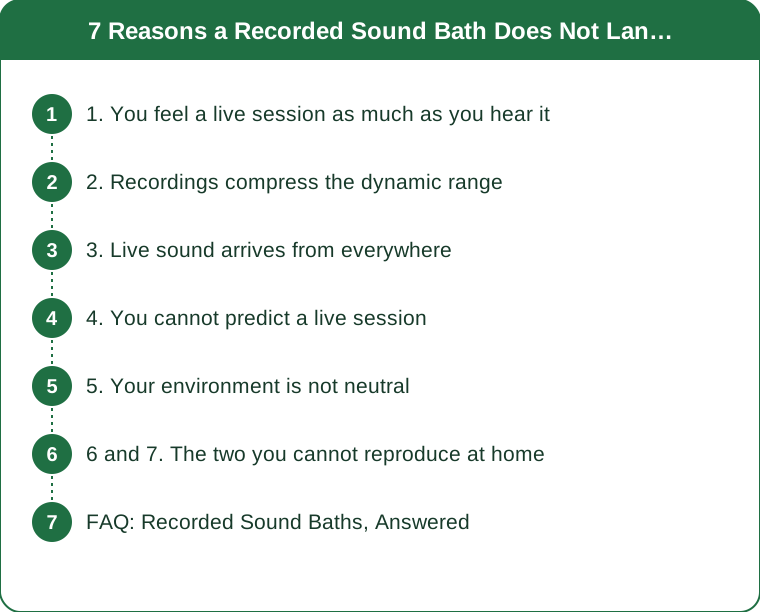
1. You feel a live session as much as you hear it
This is the largest difference and the hardest to reproduce.
Gongs and large singing bowls produce substantial energy at low frequencies — well below where hearing dominates and into the range your body registers as vibration. In a room, that energy reaches you through the air and through the floor. You feel it in your chest, in your sternum, along the surface of your skin.
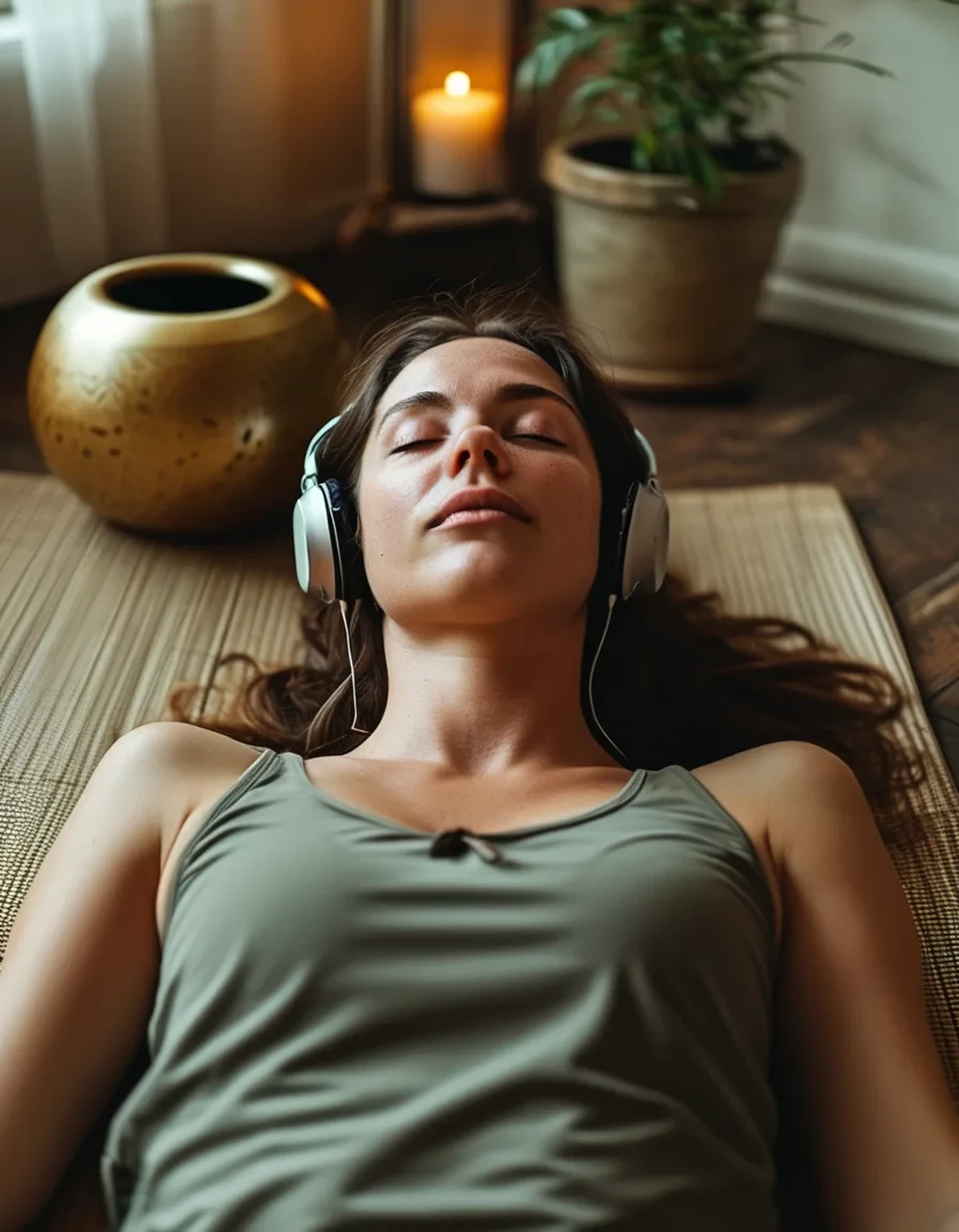
Headphones deliver almost none of it. Small drivers close to the ear reproduce the audible component and essentially none of the physical one. Even good headphones with strong bass extension produce a sensation in your ears, not in your ribcage.
This matters because that physical component is a large part of what makes a sound bath feel distinct from listening to music. The sensation of being inside the sound is a literal description of a physical situation, and reproducing it requires moving air at volume.
A subwoofer in a room gets some of the way there, which is why a good speaker system at reasonable volume is a much closer approximation than headphones — a fact that surprises people who assume headphones are the more immersive option.
2. Recordings compress the dynamic range
A live session moves between near-silence and considerable volume, and that range is part of the effect.
Recording and mastering necessarily compress this. A recording engineered to be listenable at normal volumes brings the quiet parts up and the loud parts down, because otherwise the quiet sections would be inaudible and the loud sections would be startling.
The result is a more uniform, less dramatic experience. The long approach to a peak and the drop into silence afterwards — often the most affecting moments in a live session — are both flattened.
Silence in particular does not survive recording well. Live silence between gong strikes is a full, present thing in a room with twenty people in it. On a recording it is an absence of signal, and most people’s environments have enough background noise that it simply does not register.
This is why recordings often feel pleasant and continuous where live sessions feel like they have shape. The shape is largely in the dynamics, and the dynamics are what the format costs you.
3. Live sound arrives from everywhere
In a room, sound reaches you directly from the instruments and then again as reflections from walls, ceiling and floor, at slightly different times and from all directions. Your auditory system builds a three-dimensional impression of a space you are inside.
A stereo recording arrives from two points. Even a well-produced binaural recording gives you a convincing directional impression through headphones, but it is a simulation constructed for a head that is not moving.
And you do move. In a live session, small head movements change what you hear, and that continuous feedback is part of what makes the experience feel enveloping rather than presented.
There is also the practitioner walking, moving an instrument around the room, sometimes passing close by. The sound source physically changes location, which no fixed recording reproduces.
Multi-speaker playback in a room recovers a good deal of this, which is another argument for speakers over headphones if you have the option.

4. You cannot predict a live session
Anticipation is one of the strongest modulators of any sensory experience, and repetition removes it.
The first time you hear a recording it is largely unpredictable and works well. By the fifth or sixth listen, your nervous system knows what is coming. The gong strike you did not expect becomes the gong strike at 14:20.
Prediction reduces the response. This is a general property of how the nervous system handles sensory input — expected stimuli produce a smaller reaction than unexpected ones.
A live session is never identical. The practitioner responds to the room, the timings vary, and there are small imperfections. That unpredictability keeps attention engaged in a way a known recording cannot.
The practical implication is straightforward: rotate your recordings. Having six that you cycle through preserves far more of the effect than having one favourite you play daily. This is the easiest of all seven differences to work around.
5. Your environment is not neutral
A studio or hall exists only for this. Your living room exists for everything else.
Even with a recording playing, the room around you carries its usual associations — tasks, objects, the possibility of interruption. Those maintain a low level of alertness that a dedicated space does not.
Interruption possibility is the significant one. In a class, nobody will knock, your phone is away, and there is nothing to attend to for an hour. At home, some part of you remains available. That availability is small and it is enough to prevent the deepest settling.
Room acoustics matter too. Sound baths in halls and studios benefit from long reverberation, which produces the sustained wash of overlapping tones that characterises the experience. A carpeted living room with soft furnishings absorbs reflections and produces a much drier sound.
Some of this is addressable — a consistent spot, phone in another room, door closed — and some of it is simply the difference between a purpose-built space and a domestic one.
6 and 7. The two you cannot reproduce at home
6. Other people are part of the mechanism
This one is underappreciated and reasonably well-supported.
Nervous systems regulate partly in response to other nervous systems. Being in a room with a group of calm, slow-breathing people is itself a down-regulating input, independent of the sound. Breathing tends to synchronise in groups engaged in the same slow activity, and that synchrony appears to support the settling.
There is also the practitioner, whose presence provides something specific: someone else is responsible for the session. You do not need to track time, decide when it ends, or monitor whether it is working. Handing over that function frees attention that would otherwise be spent supervising yourself.
At home, you are both participant and facilitator. Part of you is always checking how long is left.
Setting a timer you cannot see, in another room, recovers a surprising amount of this. It is a small change and one of the more effective ones available for home listening.
7. Live sessions have a beginning you had to travel to
The journey is part of the experience, and removing it removes something real.
Getting to a session involves deciding to go, travelling, arriving, and entering a space where the ordinary rules do not apply. That sequence is a transition ritual, and transitions signal to the nervous system that context has changed.
Pressing play involves none of it. You go from whatever you were doing straight into the session, carrying the whole state of the previous activity with you.
A short transition ritual at home recovers a good deal of this — five minutes of doing nothing before starting, changing clothes, dimming the light, lying down for a while before pressing play. It feels unnecessary and it changes the session.
There is also a commitment effect. Having travelled and paid, you are unlikely to leave halfway. At home, the option to stop is always available, and its availability keeps a decision in play throughout.
None of this means recordings are not worth using. Frequency has its own value, and a ten-minute recording three times a week almost certainly does more over a year than one live session a month. The realistic approach is both: recordings for regularity, live sessions for depth. This is general information — sound practices are relaxation tools, not treatments for medical conditions.
FAQ: Recorded Sound Baths, Answered
Are headphones or speakers better for a recorded sound bath?
Speakers, if you have any option at all, and ideally with some bass extension. Headphones deliver detail and isolation but lose the physical low-frequency component that distinguishes a sound bath from ordinary listening. If headphones are the only option, over-ear ones with good bass response are much closer than earbuds.
Does it matter what volume I use?
More than most people expect. Sound baths played quietly become background music and lose the effect almost entirely. A comfortable but definite volume — loud enough that it fills the room rather than sitting in it — works considerably better, which is one reason headphones remain popular despite their limitations.
Can I fall asleep to one?
Many people use them exactly that way and it is a perfectly reasonable use. It is a different thing from an awake session, where the point is sustained relaxed attention rather than unconsciousness. If you want the awake version, sitting propped up rather than lying flat helps a great deal.
TL;DR:
- Live sessions deliver low-frequency energy you feel physically; headphones reproduce almost none of it — speakers are much closer.
- Recording compresses the dynamic range, which flattens the peaks and destroys the silences that give a session its shape.
- Live sound arrives from all directions and moves; a recording arrives from two fixed points.
- Repetition makes recordings predictable, and prediction reduces the response — rotate several rather than replaying one.
- Group co-regulation and handing responsibility to a practitioner are real mechanisms you cannot reproduce alone.
The useful conclusion is not that recordings are inferior but that they are a different tool. Regularity is worth a great deal, and a short recording several times a week almost certainly outperforms an occasional live session over a year — provided you rotate them, play them properly loud, and give yourself five minutes of transition before pressing play.
Keep Reading
This article is for general informational purposes only and is not medical advice. Always consult a qualified health professional for guidance specific to you.